Who Bears the Burden?
Heterogeneous Racial Approval Differentials in U.S. Mortgage Lending — causal forest double ML on 42.3 million applications.
The Discovery in One Figure
The gap is driven by human discretion, not automated scoring
The Paper in Five Minutes
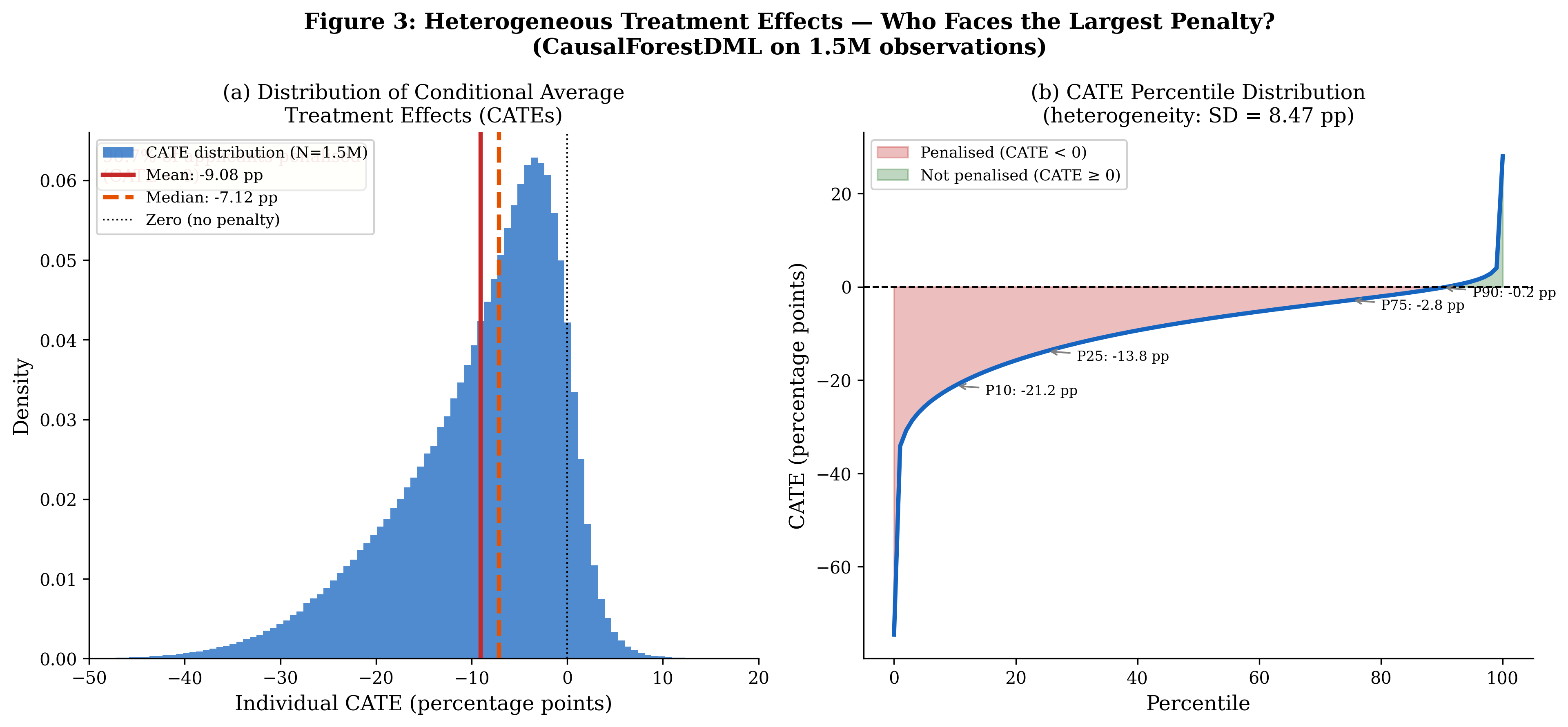
Knowing the average approval gap is not enough — averages hide who actually pays. Using methods from modern causal inference (the same family behind clinical-trial analysis), this paper estimates the approval penalty for each applicant profile across 42 million mortgage applications. The distribution is wide: nine in ten Black applicants face some estimated penalty, and the decisive factor is not the applicant but the process — applications handled by human underwriters carry more than double the penalty of those decided by automated systems. That points the fairness question at something a regulator can act on: how applications are routed.
The Research Question
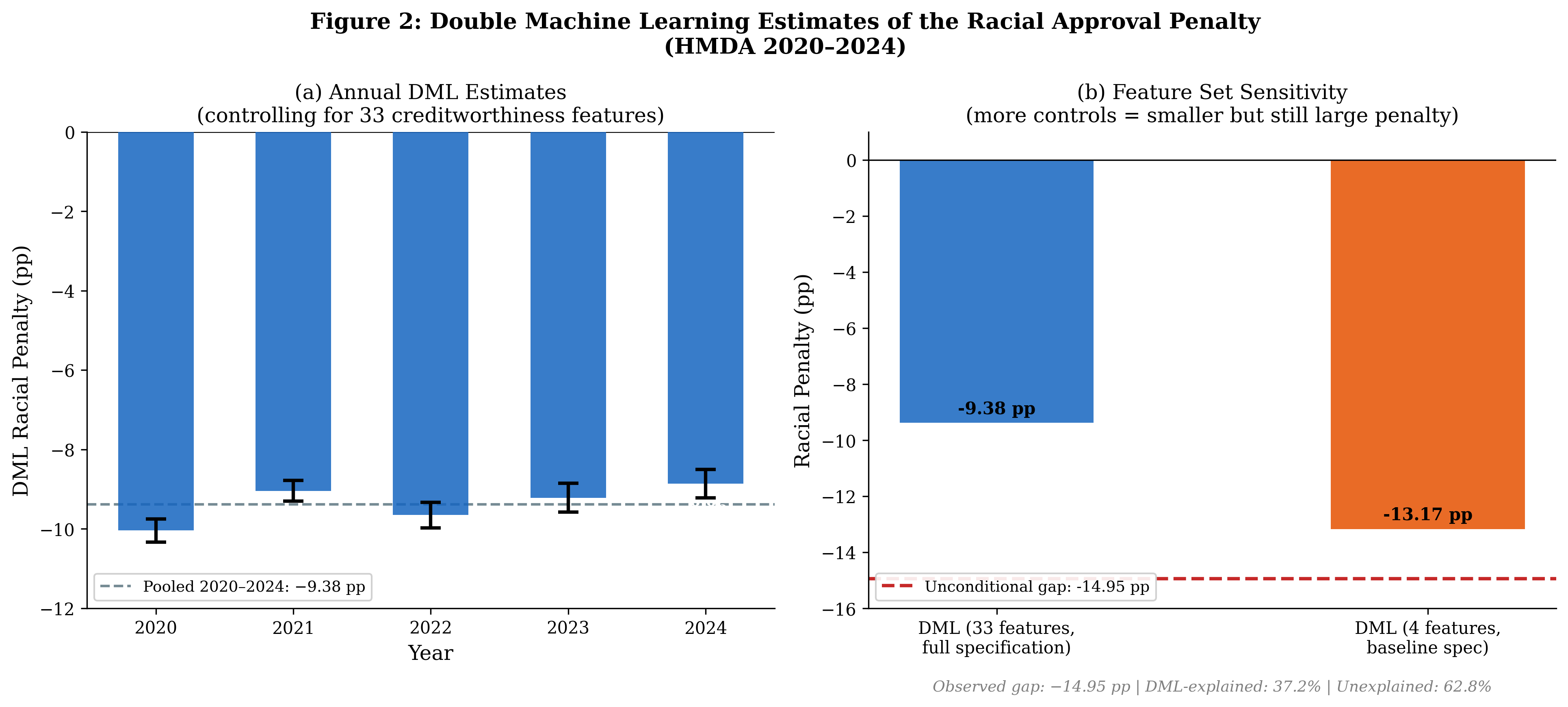
Across 42.3 million HMDA mortgage applications (2020–2024), the raw Black–White approval gap is 14.95 percentage points. The interesting question is causal, not descriptive: how much of that gap survives once genuine creditworthiness is accounted for — and who, specifically, bears it?
How It Works
I estimate individual-level conditional average treatment effects with double machine learning (LightGBM nuisance models, cross-fitting) and causal forests, adjusting for 33 creditworthiness controls — income, LTV, DTI, loan purpose and type, automated-vs-manual underwriting, and geography. Cross-fitting removes regularization bias so the effect estimate is not contaminated by the prediction models.
The headline estimate is triangulated across five independent identification strategies — DFL decomposition, within-lender fixed effects, RDD at the 80% LTV PMI threshold, difference-in-differences across the 2022–24 tightening, and Manski partial-identification bounds. A race-shuffle placebo yields a 17.9× signal-to-noise ratio; the DR-Learner replicates the estimate within 0.15 pp.
The Results
A −9.39 pp mean conditional penalty remains after controls — 62.8% of the raw gap is left unexplained by observable creditworthiness. 90.7% of Black applicants face a negative conditional effect, and the penalty is largest under manual underwriting (−14.8 pp) versus automated systems (−6.2 pp), implicating human discretion over algorithmic scoring as the dominant channel.
Conditional approval penalty by underwriting channel
Bar length = size of the estimated Black–White differential (all negative). The channel, not the applicant, is decisive.
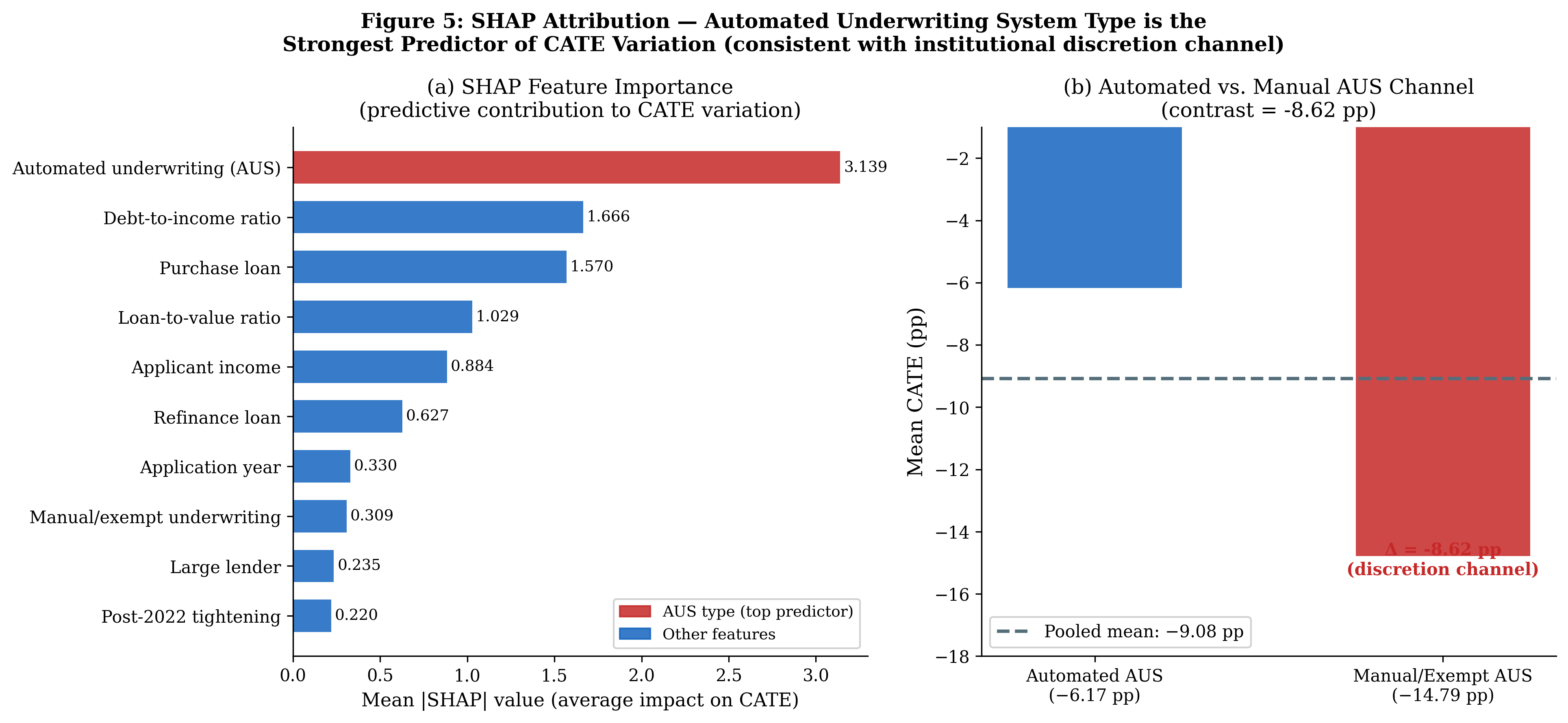
Level treated as an upper bound (no credit scores in HMDA); the channel contrast is the robust object.
What This Changes
It points the fairness question at an actionable mechanism — lender-controlled routing and handling of applications — rather than at applicant characteristics. A regulator can act on how applications are routed; an applicant cannot.